
Try it: make real picks
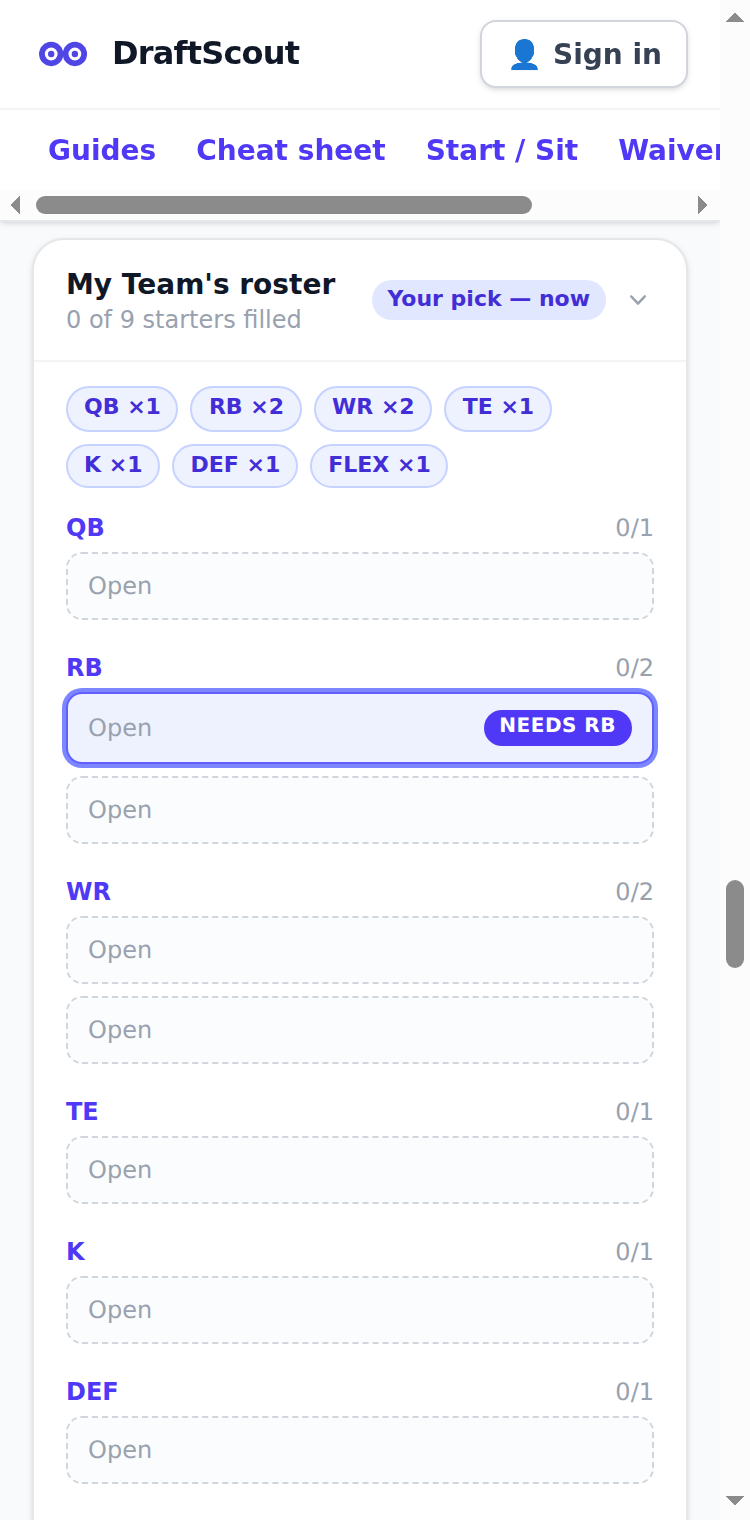
Set your league size and pick slot, then tap players as if you were on the clock — DraftScout recommends a best pick with its reason, exactly like the live draft tool.
Loading live player data…
This demo uses the app's default roster and PPR scoring — your league's settings may pick different.
Your exact snake pick numbers
Set your league size and pick slot — the serpentine math below is exact (odd rounds run 1→N, even rounds run N→1), not an estimate.
| Round | Overall pick | Direction |
|---|---|---|
| 1 | #4 | ascending |
| 2 | #21 | descending |
| 3 | #28 | ascending |
| 4 | #45 | descending |
| 5 | #52 | ascending |
| 6 | #69 | descending |
| 7 | #76 | ascending |
| 8 | #93 | descending |
| 9 | #100 | ascending |
| 10 | #117 | descending |
| 11 | #124 | ascending |
| 12 | #141 | descending |
| 13 | #148 | ascending |
| 14 | #165 | descending |
| 15 | #172 | ascending |
| 16 | #189 | descending |
Opens the setup with your league size pre-selected — your first draft is free, no signup needed until you want to save it.
Snake Draft Strategy 2026: Every Pick & Round
The snake draft is the format most of us grew up on: the order runs 1 through 12, then reverses — the team at 12 gets the first pick of round two, and the team at 1 picks last. "Snake" is the shape the order makes as it coils back and forth. The design is simple fairness: no one picks first in every round.
But the strategy is anything but simple. Every pick slot has its own personality, positional runs will roll over you whether you're ready or not, and the whole draft is a long exercise in managing what's left rather than choosing what's best. This guide breaks down how snake order actually works, what each pick slot should do, how scarcity changes by format, and how to survive the runs.
Put this into action
Snake draft pre-selected — add your league's roster, scoring, and pick slot, then draft live.
Let the assistant track the board
The hardest part of snake drafting isn't knowledge, it's tracking. By round 8 you're juggling your roster, the remaining pool, the teams still needing QBs, and your own queue. That's a lot of plates.
DraftScout handles the bookkeeping: set your league size, your pick number, your position counts, your scoring format, keepers and your fade list — then tap players as they're taken and the app tracks the board for you. When your pick comes up it surfaces the best available player for your team, with an honest reason line explaining the recommendation. You stay in the driver's seat; it keeps the scoreboard.
Ready to feel how it plays? Start a free snake draft with your league's real settings and run a practice board — no signup needed until you want to save your draft. Start your free draft →
Set up your draft
Run this plan against your league's real settings — the setup opens with Snake draft pre-selected, ready for your roster, scoring, and pick slot.
How snake order works (and why the middle is a trap)
In a 12-team league, the snake goes:
- Round 1: 1, 2, 3, 4, 5, 6, 7, 8, 9, 10, 11, 12
- Round 2: 12, 11, 10, 9, 8, 7, 6, 5, 4, 3, 2, 1
- Round 3: 1, 2, 3, …
The team at pick 12 picks twice in a row (the 12th pick of round 1 and the 1st of round 2) — that's the "turn," and it's the most powerful moment in the draft. The team at pick 1 picks once at the top of every round. Both of these are genuinely good positions. Pick 1 gets the best player in the league and frequent first crack at the next tier; pick 12 gets two consecutive picks and can build a coherent pair (RB+RB, RB+WR) every time the board swings back.
The trap is the middle. Picks 4–9 in a 12-teamer look comfortable — you're never last, you're never first — but you're never close to anything either. Twenty-two picks separate your selections. Every plan you make between picks gets broken by the teams around you. The middle isn't a bad slot; it's a slot that punishes rigidity harder than the ends. You need flexibility, not a pre-written board.
Set up your snake draft
The order above runs live in the app — enter your league size and pick slot and DraftScout applies the same serpentine math to your real board. Snake draft pre-selected.
What to do at every pick slot
Early picks (1–3): take the elite, then react
At pick 1, you take the best player on the board. In most formats that's the top running back or the consensus overall pick; in superflex it can be a quarterback (see the superflex guide). Don't overthink pick 1. The entire point of the slot is a premium asset at a premium price.
After the first round, early picks are a waiting game: you pick once, then watch 20+ selections go by. Use the gap to draft the shape of your roster, not a fixed name list. The classic early-slot failure is assuming your second-round target will survive to you — he often won't. Have a tier of acceptable outcomes, not one name.
The turn (picks 10–12 in 12-team): build pairs
The turn is where snake drafts are won. You get back-to-back picks, so you get to construct a pair — and you should always pair within the same position tier or complementary positions. Classic turn builds:
- RB-RB: two starting-caliber running backs before the RB run detonates. The most common turn anchor, and for good reason — RB is the thinnest position.
- RB-WR: one each, covering the two most expensive positions before scarcity hits.
- RB-TE (or TE-WR): grabbing an elite tight end at the turn is a sleeper-leaner's move; you give up a second starter for a positional edge that lasts all season.
The turn's superpower: you can commit to a strategy with your pair and then draft to support it. Pair RB-RB and your next several picks are wide receiver and quarterback focused. Pair TE-early and you free your middle rounds from tight end roulette entirely.
Late-middle (picks 7–9 in 12-team): stay fluid
You're far enough from the ends that the board will dictate to you. The play here is best available at a premium position — running back, wide receiver, and (in superflex) quarterback — and being ready to shift. If the room starts a QB run before you're ready, don't panic into one; the run means good receivers are falling to you. Value follows runs. Chasing a run is how you end up with last round's players at this round's prices.
Set up your snake draft
Turn this section into your league's real board — DraftScout fits each pick to your exact roster, scoring, and slot.
Positional scarcity by format
The single biggest lever on snake strategy is how many starters you have to field at each position — your league's settings — because scarcity is what drives value, and value is what drives picks.
- Standard 1-QB, 2-RB, 2-WR: running back is the scarce commodity, so early RB investment is the classic play. Quality RBs dry up by round 3–4; receivers are deep all draft.
- PPR / half-PPR (3 WR or flex-heavy): the more receivers you start, the more WR value rises. In full PPR with 3 WR slots, elite receivers are legitimately first-round assets, and the WR3 tier is worth more than people remember.
- Superflex: quarterbacks become the scarcest asset on the board — 12 teams need ~24-26 starting QBs (superflex slot plus QB). QBs fly in round 1–2, and teams that wait often end up with one QB (see Superflex Draft Strategy 2026).
- TE-premium (TE-PPR): tight ends get a points boost, which pushes the elite TEs (the top 2–4 at the position) up several rounds. It also means the TE dead zone starts earlier — the gap between the elite and everyone else widens.
The practical takeaway: know your league's starting requirements before you walk in. The same pick slot plays completely differently in 2-RB standard vs. 3-WR PPR vs. superflex. DraftScout's setup screen takes your exact position counts and scoring format — including superflex and TE-premium — and its live recommendations are computed against your settings, not a generic board.
Set up for your format
Scarcity is a settings question — DraftScout computes every pick against your exact roster, scoring, superflex, and TE-premium settings. Snake draft pre-selected.
When the board runs on you
A run is when three or four teams in a row take the same position — QBs, tight ends, handcuff RBs, defenses in the silly late rounds. Runs are the most psychologically dangerous part of a snake draft, because the instinct is to join one out of fear.
The counter-intuitive truth: runs are gifts. When four teams take quarterbacks in rounds 5–6, that's four teams not taking receivers and running backs — which means the next best WR/RB slides to you. The players who fall because of a run are usually as good as the ones being taken; the run's participants are the ones overpaying in opportunity cost.
Rules for surviving runs:
- Never start a run unless the position is truly thinning and you need it (e.g., you're the last team without a starting QB and the QB pool is drying up — then you must move, not because of the run but because of your roster).
- Never panic-join a run. If a run is happening at a position you didn't plan to take, let it happen — the fallout lands in your lap at the other positions.
- Use runs to get your own runs. If you notice two or three teams near you all need tight ends and you already have one, quietly watch the TE run start, then grab the value that falls at WR.
The discipline here is exactly what a live assistant gives you: DraftScout tracks your open roster slots in real time and recommends the best available player for your team as it stands — so when the board runs on you, you get a calm, computed answer instead of a knee-jerk one. Every recommendation includes a reason line, so you see the logic and keep the final call.
Stay calm when the board runs
A live board is the antidote to runs — DraftScout tracks your open slots in real time and recommends the best available player for your team as it stands. Snake draft pre-selected.
Keepers change the math
If your league carries keepers into the draft, the snake math shifts in one important way: the highest-value players may already be off the board. The top-10 overall player kept by someone else at a discount isn't available to you. That pushes the effective board down a tier — your "first round" is really the second tier of players, and the keeper value players are gone before round 1 starts.
The strategic effects:
- Scarcity concentrates. If every team keeps their best player, the draftable pool of elite RBs is thinner than the ranking lists suggest.
- Pick slots shift value. Late-round picks become slightly more valuable when the keeper discount is concentrated at the top (the player kept by the pick-12 team isn't there to take).
- Plan around the kept board, not the ranking board. Cross kept players off your sheet before you build your pick strategy.
We cover the full keeper decision (keep vs. cut, cost models) in the Keeper League Draft Guide 2026. In the app, keeper mode works the same way: you enter the players your league is keeping, they're marked off the board, and DraftScout never recommends a player who's already kept.
Set up your keeper draft
Keeper mode marks kept players off the board, so DraftScout never recommends someone who's already kept in your league. Snake draft pre-selected.
Round-by-round shape: a rough template
One caveat before the template: your league's settings override everything here. This is a starting shape for a typical 12-team, 1-QB, 2-RB, 2-WR + flex PPR league — adjust for your own format.
- Rounds 1–2: Your foundation. RB/RB, RB/WR, or (if the board forces it) an elite TE or QB. Two starters you never think about again.
- Rounds 3–5: Complete the starting core. Your second/third WR, your QB, your flex. This is where PPR and superflex settings bite hardest — know your scarcity.
- Rounds 6–9: Depth plus a speculative pick or two — the upside RB handcuff, the rookie WR on a good offense. This is where "best available" quietly becomes "best upside."
- Rounds 10–14: Your starters are set. Now it's bench, handcuffs, a second tight end if your format rewards it, and a defense/kicker at the very end. Never take D/ST or K before the last two rounds; they're interchangeable week to week.
This is the shape, not the gospel. Every board changes it. What the template buys you is knowing where you are — and knowing where you are is most of snake drafting.
Run the template on your board
The shape becomes your real first rounds once your settings are in — DraftScout fits each pick to your exact roster and scoring. Snake draft pre-selected.
Best snake draft position
There's no single "best" snake slot. Every position in the order wins somewhere and loses somewhere, and the right answer depends on your league size, your scoring format, and how you like to draft. The honest truth: the ends (early and at the turn) are the easiest to plan around because their timing is predictable; the middle is harder, not worse.
| Slot | Picks (12-team) | Pros | Cons | It fits you if… | |---|---|---|---|---| | Early | 1–3 | One elite anchor at the top of every round; a clear first pick | Long waits between picks; your plans get broken | You want one premium stud and can stay patient | | Middle | 4–9 | Never far from value; no extreme waits | 22 picks between selections; the board dictates to you | You stay fluid and trust best-available | | At the turn (also the late slot) | 10–12 | Back-to-back picks build a coherent pair every swing | Longest single waits; you must accept what falls | You like drafting in pairs and committing to a build |
League size shifts the whole picture. In an 8-team league there are fewer teams, so each position runs deeper relative to your starters — elite running backs aren't as scarce, the middle pick gap shrinks to 14, and the turn comes around more often. In a 14-team league the squeeze is on: the starter pool is smaller, scarcity hits earlier and harder, the middle picks (roughly 5–10) get even longer between selections, and you have to address scarce positions a round or two sooner than your gut says. For the deeper treatment of which slot fits your style, see Best Draft Position in Fantasy Football.
See your slot in the app
There's no generic best slot — set your actual pick number and league size and see what DraftScout recommends for your spot. Snake draft pre-selected.
Snake pick numbers by league size
The serpentine rule is simple and exact: odd rounds run low to high, even rounds run high to low. That single rule generates every pick number in every round. Here are the first six rounds for the four most common league sizes ("→" reads "through," so 1→8 means 1, 2, 3 … 8):
| Round | 8-team | 10-team | 12-team | 14-team | |---|---|---|---|---| | 1 | 1→8 | 1→10 | 1→12 | 1→14 | | 2 | 8→1 | 10→1 | 12→1 | 14→1 | | 3 | 1→8 | 1→10 | 1→12 | 1→14 | | 4 | 8→1 | 10→1 | 12→1 | 14→1 | | 5 | 1→8 | 1→10 | 1→12 | 1→14 | | 6 | 8→1 | 10→1 | 12→1 | 14→1 |
Check any cell by hand: in a 12-team league, round 1 is 1 through 12, round 2 flips to 12 through 1, round 3 flips back to 1 through 12, and so on. That's why the last picker gets two consecutive selections — they take the last pick of an odd round and the first pick of the next. Full tables for every pick in these formats live here: snake draft order, the 12-team snake draft order, and the 14-team snake draft order.
Get your exact pick numbers
The odd/even rule is what the app runs live — enter your league size and pick slot and your exact round-by-round order is on the board. Snake draft pre-selected.
Round-by-round skeleton (12-team, roughly)
The template above gives you the shape; this drills it down into a working round-by-round plan. The numbers below are a real example for a mid-slot team (pick 6 in a 12-team) — the pick numbers come straight from the odd/even rule in the previous section, so you can see exactly how far apart your selections land. Treat it as an illustration of what to be thinking at each stretch, not a promise; your settings and your board override everything here.
| Stretch | Rounds | Pick # (slot 6) | What you're thinking | |---|---|---|---| | Foundation | 1–2 | 6, 19 | Two anchors — RB/RB or RB/WR depending on your format | | Core | 3–5 | 30, 43, 54 | Finish your starters: second WR, flex, and your QB | | Stability | 6–7 | 67, 78 | Depth plus ceiling — the upside handcuff, the breakout WR | | Upside | 8–9 | 91, 102 | Best-upside available; the speculative tailend shots | | Depth | 10–12 | 115, 126, 139 | Bench, a second TE if your format rewards it, stashes | | Endgame | 13–14 | 150, 163 | Handcuffs, then D/ST and kicker dead last |
The pattern to notice: your anchors are settled by pick ~19, your starting lineup is complete by ~54, and everything after that is upside and bench. If you're not at pick 6, shift the numbers yourself using the odd/even rule — it's the same rhythm, just at different pick numbers.
Turn the skeleton into your draft
This round-by-round rhythm is what DraftScout's live recommendations follow — set your league size and slot and watch each pick fit your roster. Snake draft pre-selected.
Pre-draft checklist
Forty minutes of prep beats forty minutes of panic. Run through this before draft night so the draft itself is execution, not decision-making under a clock:
- Confirm your league settings — scoring format (PPR / half / standard), roster positions, superflex or TE-premium, roster size. These change everything.
- Lock your pick slot — know your exact number and what it means (early, middle, or at the turn).
- Write your fade list — the players you won't draft no matter what. It saves you from talking yourself into them.
- Plan your first three rounds at each plausible slot — you don't know how the board will fall, but you can know what you'd do at each of your possible picks.
- Know your keepers if your league keeps players — mark them off the board before the draft starts.
- If it's an auction, sketch your budget tiers before round 1 and pick a max-bid ceiling per slot.
Grab the full interactive version with progress tracking at the Fantasy Football Draft Checklist.
Your checklist, in the app
Set up now with your exact settings, keepers, and fade list — then draft night is execution, not forty minutes of panic. Snake draft pre-selected.
FAQ
What's the best snake draft position?
There isn't one — each slot trades one kind of advantage for another. Early gives you an elite anchor, the turn gives you back-to-back picks (a pair), and the middle keeps you close to value but demands flexibility. Pick the strategy that matches your style, not a magical slot.
Is a 12-team league that different from a 10-team?
Yes, in one important way: scarcity. With two more teams, the starting pool is smaller and the scarce positions (running back above all) dry up sooner. A 10-team plan that waits on RB can work; the same wait in a 14-teamer usually doesn't. The smaller the league, the deeper every position runs.
How many running backs should I take early?
It depends on your format. In standard 2-RB leagues, RB is the scarce commodity, so going RB-heavy early (RB-RB, or RB-RB plus more) is the classic play. In 3-WR or full-PPR formats, receiver value rises and a RB-WR split is usually smarter. Let scarcity — not habit — set your mix.
Does scoring change the plan?
It can flip it. Superflex makes quarterbacks the scarcest asset and pushes them to round 1–2; TE-premium boosts the elite tight ends several rounds; full PPR lifts receivers. Always set your plan from your actual scoring, because a plan built for standard settings can misprice players in PPR.
Snake or auction?
Snake is simpler, faster, and more familiar — every team gets the same total set of picks in an equitable shape. Auction gives every player an equal shot on a shared budget, which rewards prep but takes longer and is much harder to run live. See Auction vs Snake Draft for the full comparison.
Set up your draft
The answers above run cleanest against your league's real settings — the setup opens with Snake draft pre-selected, ready for your roster, scoring, and pick slot.
Cross-links
- Auction leagues are a different animal entirely — see Auction Draft Strategy 2026 for budget tiers and when to bid.
- Your pick-slot plan shifts with league size — see the 8-team, 10-team, 12-team, and 14-team depth maps.
- Not sure snake is the right format? Auction vs Snake Draft 2026 weighs how the two compare on fairness and fit.
- Superflex is the most popular snake format variant — Superflex Draft Strategy 2026 covers the QB question.
- Want a printable reference to keep beside the board? Grab the DraftScout Cheat Sheet.
- Keeping players this year? Read the Keeper League Draft Guide 2026 before you set your board.
- Stuck between two players at your pick? Compare them side by side from live data — DraftScout Player Comparison.
Set up your draft
Every strategy on this page is a plan to run — open the setup with Snake draft pre-selected and turn it into your league's live board.